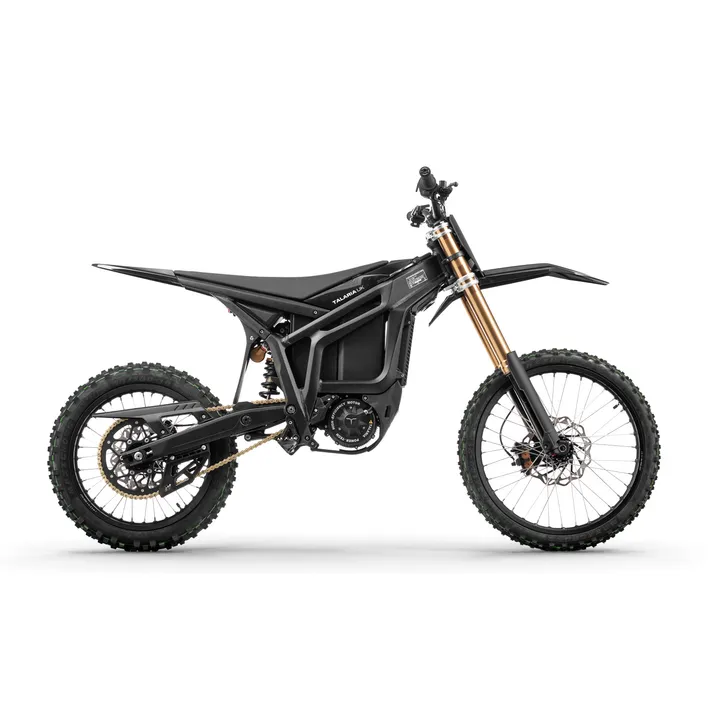
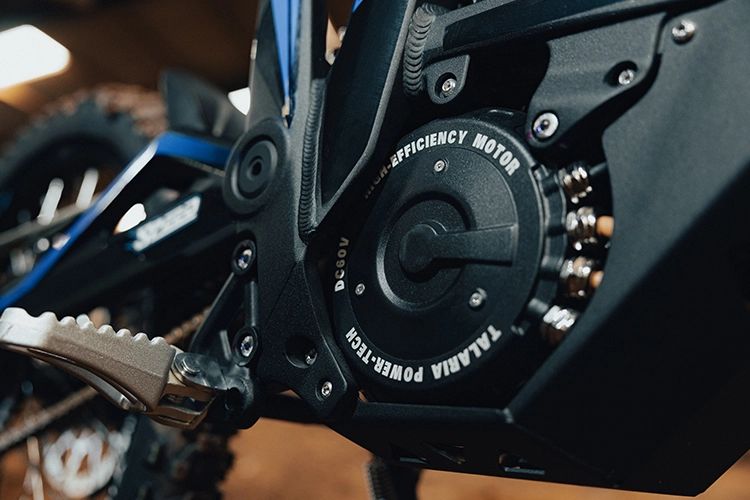
Search for a Talaria ebike, a Talaria e bike or a Talaria electric bike and you will find thousands of UK riders using those phrases every month. It is a completely natural thing to call it — a Talaria is a bike, and it runs on a battery. But in UK law, “electric bike” is a precise legal term, and a Talaria is not one.
That distinction is not pedantry. It decides where you can legally ride, whether you need a licence and insurance, and whether the police can seize your bike. Here is the honest version.
What UK law calls an electric bike
The legal category most people mean by “e-bike” is an EAPC — an Electrically Assisted Pedal Cycle. To qualify, a machine must:
- have working pedals that propel it
- have a motor of no more than 250 W continuous output
- stop assisting at 15.5 mph (25 km/h)
- carry a plate showing power output and either the manufacturer or the battery voltage
Meet all four and the law treats it as a bicycle. No licence, no registration, no insurance, no helmet requirement, and you may use cycle paths.
Why a Talaria is not an EAPC
A Talaria fails the test on every count. Take the Talaria Sting R: no pedals, 8 kW of peak power — thirty-two times the EAPC limit — and a 55 mph top speed off-road. The Talaria Komodo produces 32 kW and 65 mph. Even the junior Talaria JR-12, at 360 W and 10 mph, has no pedals and so cannot be an EAPC.
So while “Talaria electric bike” is fine as everyday language, the legal reality is different:
| What people call it | What UK law calls it |
|---|---|
| Talaria e-bike / electric bike (MX models) | Off-road motorcycle — private land only |
| Talaria e-bike (road-legal L1E) | Moped, 28 mph restricted, CBT from 16 |
| Talaria e-bike (road-legal L3E) | Motorcycle, A1 or higher licence |
| An actual e-bike (EAPC) | Pedal cycle — 250 W, 15.5 mph, has pedals |
So what class is a Talaria?
There are three answers, depending on which model you buy.
Off-road (MX) — private land only
The Talaria X3 MX Pro, Sting R, Sting Pro and Komodo in standard form are unregistered off-road motorcycles. There is no licence, tax, MOT or registration — but there is also no legal right to ride them on a road, pavement, cycle path or bridleway. They belong on private land with the landowner’s permission, or at a pay-and-ride track.
L1E road-legal — moped class
The X3 Pro Road Legal, Sting R L1E and Sting Pro L1E are EEC type-approved as L1E mopeds, restricted to 28 mph. Register, tax and insure them and you can ride on public roads from age 16 on a CBT with L-plates.
L3E road-legal — motorcycle class
The Komodo L3E is type-approved as a full L3E motorcycle: 59 mph restricted, 32 kW, and it needs an A1 or higher motorcycle licence. It is a motorcycle in every legal sense.
Where riders get caught out
Because “e-bike” sounds harmless, some buyers assume a Talaria can be treated like a pedal cycle. It cannot. Riding an unregistered off-road Talaria on a public road risks a fine, penalty points on any licence you hold, and seizure of the bike under Section 59 of the Police Reform Act.
The fix is simple: ride MX models on private land, and buy a road-legal L1E or L3E if you want to use the road. Talaria UK sells both, so you do not have to compromise or modify anything.
Choosing the right Talaria electric bike
- Track and private land only? An MX model gives you the most power for the money — the Sting R at £3,495 or the Komodo at £5,199.
- Want to ride on the road at 16? An L1E model on a CBT — the X3 Pro Road Legal from £3,195.
- Full motorcycle licence and want the fastest road-legal Talaria? The Komodo L3E.
Not sure? Our which Talaria is right for you tool narrows it down in a minute, and do you need a licence for an electric dirt bike covers CBT, insurance and age limits in full.
Frequently asked questions
Is a Talaria an e-bike?
Not in the legal sense. People call it a Talaria e-bike because it is a battery-powered two-wheeler, but UK law reserves the 'electric bike' category (an EAPC) for pedal-assisted bicycles limited to 250 W and 15.5 mph. A Talaria has no pedals, makes far more power and is legally either an off-road motorcycle or, in L1E/L3E form, a registered moped or motorcycle.
What class of e-bike is a Talaria?
A Talaria is not an EAPC class at all. Off-road (MX) models such as the Sting R and Komodo are unregistered off-road motorcycles for private land. Road-legal Talaria models are EEC type-approved as either L1E (moped class, 28 mph restricted, CBT from 16) or L3E (motorcycle class, requiring an A1 or higher licence).
Can I ride a Talaria electric bike on a cycle path?
No. Cycle paths and cycle lanes are for pedal cycles and EAPCs. Because a Talaria is not an EAPC, riding one on a cycle path, pavement or bridleway is not permitted. Off-road models are for private land with the landowner's permission; road-legal L1E and L3E models belong on the road, taxed and insured.
Do I need a licence for a Talaria electric bike?
For off-road MX models used on private land, no licence or registration is required. For a road-legal L1E model you need at least a CBT plus a provisional licence, and you can ride from age 16 with L-plates. L3E models such as the Komodo L3E need a full A1 or higher motorcycle licence.
Is a Talaria electric bike road legal in the UK?
Standard off-road versions are not. Talaria UK also sells factory road-legal variants that are EEC type-approved, so they can be registered with the DVLA, taxed (electric bikes often qualify for a £0 rate) and insured for road use.
Models mentioned in this guide
- Talaria Sting R More power, more performance. The all-new air-cooled Sting R is the industry-leading electric dirt bike for UK riders.
- Talaria X3 MX Pro Bold & brash. The lightest bike in the range at just 53 kg — designed for the modern urban explorer.
- Talaria Komodo Own the horizon. 32 kW peak, 754 Nm of torque and 0–60 mph in 4.5 seconds — the apex of the Talaria range.