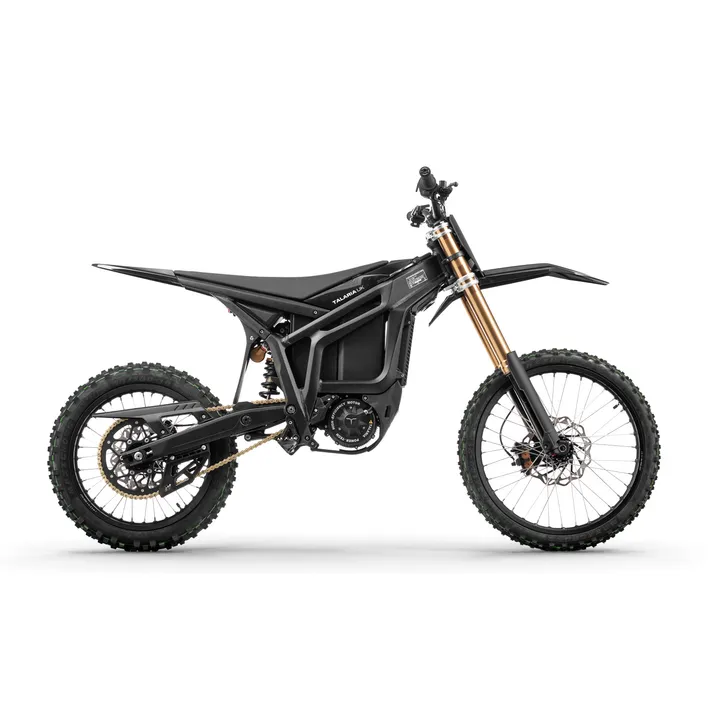

Insurance is the question that catches most new Talaria owners out — usually the week after the bike arrives. The answer is genuinely simple once you separate two situations: riding on the road and riding on private land. Everything else follows from that.
We are the UK Talaria distributor, not an insurance broker. This guide explains how cover works so you can buy the right policy — we do not sell insurance and receive nothing from those who do.
When Talaria insurance is legally required
On a public road: always. A road-legal Talaria — any L1E or L3E model — is a registered motor vehicle. Under the Road Traffic Act it must be insured for at least third-party cover from the moment it is on a public road, and that applies whether you are riding it or it is parked at the kerb. Riding uninsured means a fixed penalty, six to eight points, and the police can seize and crush the machine.
On private land: not legally. An off-road MX model ridden with the landowner’s permission needs no road insurance, no tax and no registration. But “not legally required” is not the same as “not worth having” — see below.
Insuring a road-legal Talaria (L1E and L3E)
Road-legal Talarias are insured exactly like any other moped or motorcycle, and the class matters:
| Model class | Example | Insured as | Licence |
|---|---|---|---|
| L1E — moped | Sting R L1E, X3 Pro Road Legal | Moped, 28 mph restricted | CBT + provisional, from 16 |
| L3E — motorcycle | Komodo L3E | Motorcycle, 32 kW | A1 or higher |
Two practical points. First, some mainstream insurers still handle electric mopeds badly and will either decline or quote absurdly — specialist motorcycle brokers are usually the answer, and they will ask for the model, the type-approval class and the VIN. Second, quote on the correct model name: a Talaria Sting R L1E is not the same risk as an off-road Sting R, and getting that wrong on the proposal form can void the policy.
What actually drives the premium
- Rider age and licence — by far the largest factor. A 16-year-old on a CBT pays a multiple of what a 30-year-old on a full A licence pays for the same bike.
- Power and class — the 32 kW Komodo L3E sits in a much higher bracket than a 28 mph L1E.
- Postcode and storage — a locked garage with a ground anchor beats a shared driveway, often substantially.
- Security — a Sold Secure chain, disc lock, tracker and marked components all pull the price down. Insurers increasingly ask for a tracker on higher-value electric machines.
- Modifications — declare everything. Undeclared changes are the most common reason a claim is refused.
Off-road and theft cover for MX models
An off-road Sting Pro or Komodo is a £4,000–£5,200 asset that usually lives in a garage or van — both prime theft targets. Even without a legal requirement, most owners take out one of:
- Off-road / trials policies — theft, fire and accidental damage, sometimes with third-party liability at organised events.
- Specified-item cover on home insurance — simple, but check the single-article limit and whether cover applies away from home. Many home policies exclude motor vehicles entirely.
- Van and transit cover — worth checking separately if you travel to trails; bikes stolen from a van are a common gap.
Ask specifically whether the policy covers the bike away from the home address, and whether the battery is included — some policies treat it as a separate item.
De-restriction voids everything
This is the one that ends badly. Removing the limiter from a road-legal Talaria breaks its EEC type approval. The moment that happens the machine no longer matches what the DVLA registered and what your insurer priced, so you are riding an unapproved, uninsured vehicle on the road — and any claim, including one where you were not at fault, can be refused.
If you want the full off-road performance, buy the MX version and ride it on private land. Our guide to Talaria speed limiters and road-legal riding explains where the line sits.
Before you buy a policy
- Confirm which class your bike is — MX, L1E or L3E. If unsure, check the model page or ask us.
- For road use, register and tax it with the DVLA first; you will need the registration to insure.
- Get quotes from specialist motorcycle brokers, not just comparison sites.
- Declare age, licence, storage and every modification honestly.
- Photograph the bike and record the VIN and battery serial for any future claim.
For the wider legal picture — CBT, age limits, L-plates and where you can ride — see do you need a licence for an electric dirt bike and UK road-legal electric dirt bikes: L1E vs L3E.
Frequently asked questions
Do you need insurance for a Talaria in the UK?
If you ride it on a public road, yes — insurance is a legal requirement for any registered L1E or L3E Talaria, exactly as it is for a moped or motorcycle. If you only ride an off-road MX model on private land, road insurance is not legally required, though theft and damage cover is still strongly advisable given what these bikes cost.
How much is Talaria insurance in the UK?
Premiums vary widely with rider age, postcode, security and the model insured. As a rough guide, a 16-year-old on a CBT insuring an L1E Talaria will pay considerably more than an experienced rider on a full licence, and the 32 kW Komodo L3E costs more to cover than a 28 mph restricted L1E. Always compare quotes from specialist motorcycle brokers rather than assuming.
Can I insure an off-road Talaria?
Yes, but not with road insurance. Off-road MX models are covered by off-road, trials or 'bike and accessories' policies that protect against theft, fire and damage while stored or in transit, and sometimes third-party liability at organised events. These are sold by specialist insurers rather than mainstream car and bike comparison sites.
Does a Talaria need tax and an MOT as well as insurance?
A road-legal Talaria must be registered with the DVLA and taxed, though electric machines commonly qualify for a £0 vehicle tax rate — you still have to tax it, it just costs nothing. New machines do not need an MOT until they are three years old.
Will insurance cover a modified or de-restricted Talaria?
Almost certainly not. Removing the speed restriction from a road-legal L1E or L3E invalidates its type approval, which in turn invalidates your insurance and leaves you riding uninsured. Declare every modification to your insurer before you ride.
Models mentioned in this guide
- Talaria Sting R L1E Road Legal The road-legal Sting R. Register it, insure it, ride it on UK roads with a CBT.
- Talaria Komodo L3E Road Legal The road-legal Komodo. 32 kW, 17-inch road wheels and L3E type approval for full UK road use.
- Talaria Sting R More power, more performance. The all-new air-cooled Sting R is the industry-leading electric dirt bike for UK riders.